Showing posts with label DDA. Show all posts

Thursday, June 2, 2022

CANDIDATE EDUCATION: On state institutions, Washington is an outlier

Data: University of Minnesota
Institute on Community Integration


It is campaign season. That means people are running for office to represent you and make choices on your behalf. We are running a series of articles on topics we think candidates should know about. We hope they are also useful to you. Please share!

-

Most states do not run large institutions for people with IDD. We still do, and it's not clear why

-

For many, it doesn’t make sense to provide services in institutions if the supports are intended to help people live the life they want in their community.

The logic: If the goals are participation and connection, then supports should be embedded and readily available in the community, as needed.

Most community supports are also much less expensive than institutional care.

But a review of national data shows Washington is one of just 13 states still operating large institutions for people with developmental disabilities .

  • This could affect Medicaid funding if intermediate care facilities, a type of institution, are used inappropriately for ongoing, long-term placement.
  • It also speaks to a legacy of segregating people with intellectual or other developmental disabilities (IDD) in Washington. Some civic leaders here mistakenly believe people with IDD are better served separately, or that institutions offer a type of IDD support only available in that setting. Neither is correct.

Lack of support is serious and can lead to crisis for individuals and their families. But operating large institutions doesn't solve the problem. Typically, crises track back to:

  • Workforce capacity
  • Failure to fund enough slots

Both require intentional work to align availability with demand. In spring of 2022, the state legislature passed a foundational bill to gather data to increase community supports and examine the need for respite and crisis support. But the work of actually building out a stable network remains.

The University of Minnesota's Institute on Community Integration, which did the national analysis, has recommendations for elected leaders, including:

  1. Address a severe workforce shortage so people can access providers and services.
  2. Use Medicaid rebalancing and other incentives to downsize and close all IDD facilities serving 16 or more people. Shift resources into individualized supports in home and community-based settings.

These align with asks from most state advocates, as well.

You can read the policy brief here: https://bit.ly/3t7XUm4


IMPORTANT CONTEXT:

Not that long ago – just a generation or soinstitutions were the only options people with intellectual and developmental disabilities (IDD) had for education or to learn workforce or life skills.

Prior to the mid-1970s, government programs could and did discriminate against people with disabilities. The Rehabilitation Act of 1973 and its Section 504 was a turning point.

  • Section 504 established the right of disabled people to equal access and opportunity to benefit from federally funded programs and services.
  • While the federal government was hashing out implementation rules for Section 504, the Individuals with Disabilities Education Act (IDEA) passed, offering schools grants to pay for special education services as long as they followed certain rules.
  • The Americans with Disabilities Act passed about 20 years later, establishing civil rights for people with disabilities, regardless of whether federal funds are in play.

Section 504 and IDEA also mandated services be provided in integrated settings. That is, people with disabilities shouldn't be segregated in order to access support. While IDEA applies exclusively to schools, Section 504 applies to any program receiving federal funding: health care, social services, or education.

The laws made a huge difference, as did a U.S Supreme Court decision from the late 1990s called Olmstead. That one said people couldn't be forced to receive long-term support in institutions. They should be able to access it in home or community settings.
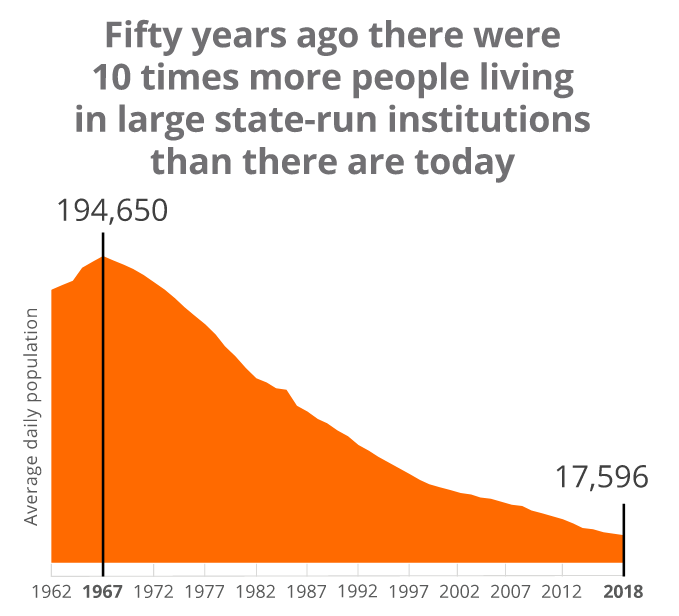
Data: University of Minnesota
Institute on Community Integration

Over the last 50 years, the number of people with IDD nationwide living in large, state-run institutions fell from about 200,000 to about 18,000, with support shifting to home- and community-based settings.

That is, today most supports come to the person, as opposed to requiring people to live in institutional settings that they otherwise wouldn't be in. 

Washington state also shifted and today most DDA clients are supported in the community. Yet we still shoulder the costs of large institutions while struggling to invest in home and community-based supports. 

In Washington, our large institutions for people with IDD are called Residential Habilitation Centers. Habilitation is similar to rehabilitiation. But where "rehab" is about helping people regain skills lost to illness or injury, habilitation is about helping people master skills that are not typically developing or that need ongoing support to maintain. A popular habilitative support for adults with IDD is job coaching. 

The state's RHCs, in turn, include a mix of nursing homes for people with IDD and intermediate care facilities for people with intellectual disabilities. Campuses have one or the other, or both. The RHC in King County, Fircrest, has both.

Intermediate care facilities are not intended for long-term placement or to provide homes. Intermediate care means people come for a regimen of active support, then return to the community. That's not how Washington was operating, though. Over the past few years DDA made changes to come into compliance, including significant investment in RHC staffing and facilities. A similar level of investment was NOT made to home and community-based supports. Last year, more than 14,000 sat on DDA's no paid services list.

During this same time, demand for crisis stabilization shot up. Three of the four RHCs don't provide that type of care,  though. Nor do they offer integrated mental health supports, a growing area of demand. People with IDD have high rates of co-occurring mental health conditions, but many mental health professionals do not work with people with intellectual disabilities, with people who are nonverbal, or with people more profoundly impacted by their developmental disabilities.

The upshot is, Washington's support system for people with IDD hasn't been providing the level of support needed, and hasn't been able to adapt to emerging need. 

VOTER EDUCATION: WHO DECIDES WHAT

In Washington, supports specific to people with intellectual and developmental disabilities are overseen by the state Developmental Disabilities Administration, part of the state Department of Social and Health Services (DSHS). These are long-term supports and are funded through Medicaid, a federal-state partnership. Support through RHCs and some smaller state residential settings are provided by state employees. Most community-based supports, though, including community residential services, are provided by private contractors, mostly nonprofits. 

State legislators:

  • Decide funding levels and things like how many slots to pay for, or which supports DDA should provide. 
  • The decision to not provide services to all DDA clients was made by legislators. 
  • The decision of how much to pay providers is also decided by legislators.

The governor:

  • As state executive, the governor is in charge of running DSHS and making sure it complies with state and federal law. The governor has staff to advise on policy and appoints people to run state agencies
  • The governor can veto bills or items from the state budget, but the governor cannot add funding. 
  • The governor can, however, make funding and policy recommendations to the legislature.

Governor appointees:

Agency leaders (appointees) and their staffs run state agencies and make day-to-day operating decisions. Agency leaders also create the rules for how agencies will comply with federal and state law. These rules affect who has access. For instance, if funds are low, DDA can narrow the criteria for who is eligible for support.


- By Ramona Hattendorf, Director of Advocacy at The Arc of King County 

Wednesday, April 7, 2021

BIG disappointment for DD advocates


Key developmental disability bill stalls in House Appropriations. Would have gathered data needed to fix funding levels for DDA services

-

Developmental Disability Administration (DDA) waiver services in Washington state are capped. And every year, state legislators - your representatives - decide how many slots to offer. They do this without a courtesy caseload forecast to inform them about level of need. The budget process they use looks at the small number of people already served, and even then it is limited. For instance, the legislature does not consider what services people want but cannot access, either because they aren't on the right waiver or because they can't find a provider.

Legislators do not consider the equity implications for those never let in, or who spend years waiting. They do not consider the economic impact of their decisions on families and the larger community.

SB 5268 - sponsored by Senators Karen Keiser, John Braun, and Joe Nguyen - is important for fixing this. The bill is titled: Transforming services for individuals with intellectual and developmental disabilities by increasing the capabilities of community residential settings and redesigning the long-term nature of intermediate care facilities.

SB 5268 would help the state understand where investment was needed for DDA community supports. It passed the Senate unanimously and sailed through the Housing, Human Services & Veterans Committee in the House. There was strong, bipartisan support.

Then it hit House Appropriations, where it died.

Fourteen of the 33 members on the Appropriations Committee represent parts of King County. So this is disappointing. Our local legislators do not understand the impact their policy choices have on their constituents with I/DD and their families. Or they do understand, but do not prioritize action.

If you care about expanding and stabilizing supports in the community, we encourage you to contact your legislators, especially if they are on the Appropriations Committee, to let them know how disappointed you are that SB 5268/DDA services died, and ask for their support going forward.


BACKGROUND AND CONTEXT

SB 5268 is about gathering information that the state needs to plan for and fund DDA services appropriately. 

DDA services are Medicaid long-term services for people with intellectual and developmental disabilities (I/DD). There is a federal match with Medicaid, so the more the state invests, the more the federal government invests. Community services are funded through a home- and community-based services (HCBS) waiver. This means people waive the right to receive support in an institution and instead request support in the community.

Currently, we are 39th in the nation in funding for community supports overall for people with intellectual and developmental disabilities, and 41st when it comes to funding HCBS waiver supports for people with I/DD. Less than 30 percent of people who meet the federal definition for needing DD waiver supports get them in our state. Supports that help individuals develop and maintain essential life skills are funded through the DDA waivers. Underfunding them directly impacts the ability of people to live and participate in their community.

The bill was funded in early versions of the Senate budget proposal, but the associated line items do not appear to be part of current budget discussions. Specific items that would now go unfunded include:

  • Courtesy forecasts of those who are assessed as eligible, and have requested services for, the Individual and Family Services (or IFS), Basic Plus, and Core waivers, and supported living services; and to produce a courtesy forecast of the number of individuals expected to reside in State-Operated Living Alternatives.

  • Funding and staffing to examine and report on a variety of topics, including but not limited to, the need for community respite beds and crisis stabilization services; to study Medicaid rates for contracted community residential providers; to develop uniform quality metrics for residential settings; and to establish a staffing plan to achieve a case management ratio of 1:35. Funding is also sufficient for rental assistance for individuals who face eviction caused by the transfer from subsidized housing to an Intermediate Care Facility.

  • Funding to perform a review of practices in other states and identify options to improve the Department of Social and Health Services practices related to client eligibility, services and managing clients.

Recently, the state crafted a plan to stabilize and grow community supports and rethink the way we use intermediate care facilities (ICFs). These facilities, as well as nursing homes for people with I/DD, are located at the state's four Residential Habilitation Centers. Years ago, people moved into RHCs for long-term stays. Medicaid now views ICFs as short-term facilities for active treatment and Washington state is in the process of adapting.

"Habilitative" services help a person keep, learn, or improve skills and functioning for daily living. This is in contrast to "rehabilitative" services, which help a person keep, get back, or improve skills and functioning for daily living that have been lost or impaired due to injury or illness.

Generally, the habilitative supports available through the DDA (commonly called "community supports" or "DD supports") are not available outside the Medicaid HCBS waivers or through private health insurance. If the state under-funds and doesn't pay for enough slots, people who are otherwise eligible simply lose access to them. Currently, there are about 14,000 people on a No Paid Services list. They are eligible for DDA supports but cannot access them because the state has chosen not to fund or track the number of waivers needed.

Friday, January 29, 2021

DDA leader Evelyn Perez will retire in April

Letter Department of Social and Health Services: A message from Secretary Cheryl Strange

re: Developmental Disability Administration, leadership change


Good afternoon,

Recently Evelyn Perez, Assistant Secretary for our Developmental Disabilities Administration, announced she is retiring after 35-years of state service effective April 30, 2021. Many of you know Evelyn as a civil rights champion for individuals with intellectual and developmental disabilities. Evelyn’s career began with the Department of Social and Health Services as an attendant counselor at Lakeland Village in Medical Lake, and rising through the ranks to serve as the DDA Region 1 Administrator. In 2013, Evelyn led the division to become its own administration and served as the first assistant secretary for the newly created administration. Her distinguished career also includes founding membership for the Latino Leadership Network – supporting and empowering Latino state employees. As Evelyn took leadership of the administration, she not only built a formidable team, she established relationships with our clients, their guardians and our legislative stakeholders, who all gained a renewed respect for her advocacy and a presence that was felt across the entire state. Her work in informing person-centered supports and services was felt across the entire department of social & health services and I am forever grateful for her and her dedication to quality and effectiveness.

Evelyn has been instrumental in leading DDA’s COVID-19 response, mobilizing many resources to ensure the health and safety of clients and staff in the community and our four state-operated campuses. Most recently, Evelyn worked with stakeholders, clients, families and others to reorganize the administration to better align with the needs of nearly 50,000 clients and 4,500 DDA staff. Under Evelyn’s leadership, DDA corrected significant deficiencies for the pre-admission screening and resident review at nursing homes and became a leader in the nation, ranking first in the country for employment and day programs. She was also instrumental in implementing a new waiver while extending services to thousands of clients who were on a wait list, and reducing the institutional footprint to meet community needs. Needless to say, she will be terribly missed.

The void created by Evelyn’s departure is vast and we are grateful for the transition period we have now through the end of April. We will use the time to conduct a national recruitment for the position. Given the innovative spirit of Washington State, especially under Gov. Inslee’s supportive leadership, we believe we can attract a wide pool of highly qualified candidates. We are determined to conduct a thorough recruitment to ensure our selection is intentional and that ultimately we hire the right person to lead the great work of DDA. I am dedicated to taking as much time as needed and to hearing from stakeholders like you.

Should an interim period occur without a new Assistant Secretary in place, I will appoint an acting Assistant Secretary. I will continue to keep you apprised of our progress.

Thank you for your interest and support of the Department of Social & Health Services and the Developmental Disabilities Administration in our work to transform lives. Evelyn’s guiding light has been the DDA mission, vision, and values and will continue to drive the work we do for many years to come. Please join me in congratulating Assistant Secretary Perez for a job well done, a career in service, and for her well-deserved retirement.

Fondly,
 

Cheryl Strange
Secretary
DSHS: Transforming Lives

Contact DSHS for questions or feedback: DDAFeedback@dshs.wa.gov

Thursday, November 5, 2020

King County finalizes legislative priorities for developmental disabilities

Don't change eligibility - protect DDA services and language access

Invest in employment and housing


King County and its Board for Developmental Disabilities, a citizen's advisory board that provides oversight of DD community services, have finalized the county's 2021 legislative priorities for developmental disabilities.

Preserve and Protect the Safety Net for Individuals with Disabilities Across Their Lifespan

Recommended Actions:

  • Maintain current eligibility criteria for state Developmental Disabilities Administration (DDA) paid services to ensure people with intellectual and developmental disabilities (I/DD) continue to access Medicaid State Plan and Waiver services including employment, community inclusion, respite, personal care, and residential services.

  • Maintain interpreter services provided by the State Health Care Authority, including video interpretation services to ensure effective delivery of essential services.

Invest in Employment and Housing for People with Disabilities to Support Economic Recovery

Recommended Actions:

  • Protect employment funding and ensure all state DDA eligible students leaving high school in 2021-2023 are added to the Basic Plus Waiver in order to receive employment and other needed services.

  • Increase the supply of affordable housing, including housing for individuals with I/DD and their families, through investments that include $250 million for the Housing Trust Fund.

The Arc of King County and representatives from its Community Change Champions and King County Parent and Family Coalition joined other community volunteers on the DD board's legislative committee to discuss and offer input on these priorities. 

The county will share and discuss them with state legislators representing parts of King County at a legislative forum on Monday, November 23. The public is invited to attend! It will be presented online, with interpretation support.

Thursday, September 17, 2020

DDA budget request for FY 2021-23


Reductions: Eligibility cuts; provider rate cuts; Residential Habilitation Center closure; wage savings for state employees; furlough days for state employees

-

This letter was shared by email from DSHS DDA:

Developmental Disabilities Administration; September 16, 2020

Dear Interested Stakeholder,

Today the Department of Social and Health Services (DSHS) Secretary Cheryl Strange announced the submission of the DSHS proposed 2021-23 biennial budget to the Office of Financial Management, which included the Developmental Disabilities Administration (DDA) budget proposal.

The agency submitted two types of proposals for the next biennium’s budget: budget requests and reduction options.  The budget requests include funding for increased services or a change in the way existing services are delivered.

Due to the coronavirus pandemic and projected budget shortfalls extraordinary proposed reductions of 15% were required by the Office of Financial Management this year. This painstaking effort included staff furloughs, administrative cuts, and provider rate reductions. Even more difficult were the substantial cuts to client services, including eligibility, which had to be made to reach the goal of a 15% reduction. Please remember that this is just the first step in the biennial budget process.  

Budget Requests:

  • Children’s State-Operated Living Alternative (SOLA): Five new SOLA homes would serve 15 children age 20 and younger on the west side of the state who are not eligible for Residential Habilitation Center admission and are not able to successfully transition to out-of-home residential placement because suitable options do not exist. ($10.7M; $5.7M GF-State; 50.1FTE)

  • High School Transition Students: Adding Basic Plus waiver capacity in anticipation that 878 eligible high school graduates will seek DDA services in the 2021-23 Biennium. ($10.3M; $5.7M GF-State)

  • Increase Children’s Intensive In-Home Behavioral Support (CIIBS) waiver capacity: Expand the CIIBS Medicaid waiver from 100 to 200 slots. ($8.7M; $4.6M GF-State; 13.2 FTE)

  • Financial Eligibility Staff: This funding for additional staff will improve the timeliness and accuracy of eligibility reviews, application processing, and case management updates, resulting in better meeting the 45-day application processing requirement. ($6.0M; $3.5M GF-State; 27.1 FTE)

  • Increase Preadmission Screening and Resident Review (PASRR) Capacity: More clients are entitled to PASRR specialized services for people with developmental disabilities. DDA is required to initiate these services within 120 days of assessment. ($4.3M; $2.1M GF-State)

  • Personal Protective Equipment (PPE): Requesting purchase of PPE for both DDA staff and for in-home caregivers. ($10.3M; $5.1M GF-State; 1.9 FTE)

  • COVID-19: New costs are related to dealing with the pandemic, including a state-operated facility (residential cottage) on the grounds of Rainier School and technology for remote supports for staff to maintain client contact without in-person visits. ($7.8M; $5.9M GF-State; 2.0 FTE)

  • Residential Habilitation Centers (RHC) Digital Records Transformation: An electronic health record system for the RHCs is necessary to maintain compliance with federal Medicaid certification standards. ($406,000; $203,000 GF-State)

  • Paper to Electronic Workflows: An electronic document management system to replace paper files is essential for staff to successfully meet client and provider needs while working remotely and to comply with federal requirements in a timely manner. ($2.3M; $1.2M GF-State; 7.0 FTE)

Reduction Options:

  • Furlough Reductions: Continuation of the Governor's  Furlough Days to achieve cost savings with two furlough days per month. (-$38.7M; -$21M)

  • General Wage Savings: Continuation of the Governor's modification of the 3% General Wage increase for EMS and WMS Positions. (-$892,000; -$512,000 GF-State)

  • RHC Cuts and Rainier Closure: Staffing reductions, cottage closures and decreased purchasing at three RHCs, and Rainier School is proposed to be closed by the end of the next biennium, June 30, 2023. (-$36.8M; -$16.6M GF-State; -283.1 FTE)

  • Provider Rate Cuts: A 2.4 percent rate cut would affect in-home caregivers, Adult Family Homes, respite providers, Adult Residential Care, and Employment and Day services providers. (-$34.2M; -$15.7M GF-State)

  • Client Eligibility Cuts: Under this option, approximately 6,500 clients with lighter care needs would temporarily lose paid services in the 21-23 biennium, including in-home personal care, residential services, SOLA and RHC. (-$490M; -$243.8M; -112.3 FTE)

The budget can and will change over time, and we appreciate the Governor’s support. As we move through this process we will be meeting with stakeholders and will keep you apprised of the budget status, particularly in regard to potential reductions. More detail can be found at this link: https://abr.ofm.wa.gov/budget/agency/requests 

Sincerely,

Evelyn Perez

Assistant Secretary, Developmental Disabilities Administration

 Contact us for questions or feedback.

Wednesday, September 9, 2020

What’s up with high school transition services?

Woman looking up from filling out a form

Recommendations are due to the state legislature in November. Community Q&A on Sept. 24

Schools in Washington state exclude and segregate students with disabilities at some of the highest rates in the nation, resulting in lack of access to a general education that will prepare them for jobs and post-secondary learning.

The Department of Social and Health Services (DSHS) agencies, the state Office of the Superintendent of Public Instruction (OSPI) and the Center for Change in Transition Services have been collaborating for a couple of years to address inequities and outcomes for high school students with disabilities, including supports to help them transition into employment. They taped a webinar on their progress and have scheduled two question and answer meetings for September 24.

Registration for Q&As:


Advocacy tip: Review the information, then raise the matter with your school board members. Their contact information should be on your school district’s website.

Ask: What are they doing to address the issues raised? School boards are the governing bodies in charge of your school district’s policies and funding choices. They also hire the superintendent, who, in turn, implements the policies and practices that the board defines for them.

If you have concerns related to your student’s IEP, then you need to work with the IEP team. Advocacy with the school board comes into play when you are advocating for districtwide policies, practices, and funding, or if you have concerns about discrimination or violations of state or federal law.

What is prompting this work?

General education access = improved outcomes

  • Washington ranks 44 out of 50 states for inclusive practices
  • 58% of students with disabilities access general education for 80-100% of the day
  • For students of color, that level of access falls to 49%
  • For students with intellectual disabilities that access falls to 6% (bottom 3 in the nation)
  • 20% of graduates with disabilities completed a diploma pathway at grade-level standard and 70% pursued an alternative option
  • 25% of students with disabilities are not engaged in any post-secondary activities one year after leaving school
  • That rises to 50% for students with intellectual and developmental disabilities.


Washington’s cross-agency transition collaborative includes the OSPI, the DSHS Developmental Disabilities Administration (DDA) and Division of Vocational Rehabilitation (DVR), their respective advisory councils, and the Center for Change in Transition Services at Seattle University.

These groups have been working with secondary transition stakeholders statewide to align efforts to improve post-school outcomes for students with disabilities. The webinar video was recorded on August 28, 2020, and provides updates on joint activities and next steps for cross-agency efforts, including the development of a final report due to the state legislature in November 2020.

As a follow up to the recorded webinar, transition collaborative members will host two live question-and-answer sessions on September 24, 2020. Please join them by registering for one of the following sessions:

Thursday, September 24, from 11 am to noon: https://zoom.us/meeting/register/tJUrceyopzwuG9yU8n3XITiyXXINRHZVBH7X

Thursday, September 24, from 3 to 4 pm: https://zoom.us/meeting/register/tJwsdeyrrzsiEtZ5WeQeUYmSqDb0U6cKypN0


Monday, August 24, 2020

Challenge? Health, supports, jobs, housing, education

In our survey to the community asking about disability supports, we asked: What Is Your Biggest Challenge?

-

Your responses follow. You can still take the surveys, and share your thoughts, here:

  • Survey: DD Long-Term Supports, https://forms.gle/rRiWBMeLxkpDEJc88

  • Survey: Early Learning and K-12 Education, https://forms.gle/7jJ2L18WuCScBv5D9

-

We will use your feedback to share with leaders and boost awareness of developmental disability

-

What is your biggest challenge? (Responses from community survey on DD long-term supports)

"Making sure my sister is properly taken care of physically and financially!"

"Continuous funding issues are scary. Current administration is slowly dismantling the social safety net."

"Transportation."

"My daughter is a relentless attention seeker. She needs to engage constantly."

"During this pandemic, not having enough knowledge with computer or subject matters to effectively help student with distance learning and trying to maintain some sort of normalcy in the life of I/DD young adult without being overwhelmed. Also, not having enough mental health staff to meet the needs of their clients."

"Isolation because of coronavirus."

"Aging and Limited Supports.Finding a Good Employment Fit. Staying Healthy. Finding Good Medical Team."

"Ensuring behavioral support stabilization, and providing MPC so my son can remain at home safely and participate in the community activities. Without the supports for both, my son could not do either of the above."

"Physical activities and my right to have fun like swimming and other activities."

"Funds."

"Policies that are restrictive ... (advocates') commitment to isolating clients in individual housing when my son would do better in larger groups."

"Getting consistent staff; getting knowledgeable support providers; finding day activities that include transportation and that are long enough to make for a full day."

"Right now all is good for us but the biggest challenge is trying to get the community as a whole to understand the full continuum of support needs and look realistically at costs in order to provide those supports."

"Getting support for my family member to go out into the community for activities and socialization."

"School District staff dismissing mine and my child’s disabilities. Denying accommodations and services."

"Finding caregivers."

"Navigating medical billing and benefits; there is zero transparency on the side of private insurers."

"No respite camps!!!!!!!!!! he needs to socialize with friends. And we need a break."

"Technology for people that need it."

"Making sure employment support is maintained through this budget crisis."

"Transportation and lack of school (and later, adult programs/outings)."

"Isolation."

"Independence, emotional control, anxiety for adult child."

"Setting up out daughter for when we parents are no longer able to care for her.

"Getting help with care so we can work and make what we need to survive and support our son. Long term thinking about what he will need as an adult. Getting what he needs in school."

"Threats of decreased funding to an already underfunded agency (DSHS/DDA)."

"Getting help with care so we can work and make what we need to survive and support our son. Long term thinking about what he will need as an adult. Getting what he needs in school."

"Insufficient day program/funding options. No college or apprenticeship programs suitable for her functioning level (these programs require a high level of functioning and independence and aren’t designed for middle-of-the-road functioning levels). A stretched case manager who rarely finds or recommends anything helpful. Few housing options, especially for those with developmental disability and mental illness."

"Finding care aides, they are underpaid."

"Right now it is the fear of losing eligibility for services and what that would mean for our family ... my son losing his job and home."

"It was his health."

"Health insurance and the time it takes to get approved coverage for necessary medical equipment."

"Health; our son's Type II diabetes is unstable. The residential staff works with him to improve his lifestyle and eating habits, but it is a challenge on both sides."

"Finding personal care providers that are well trained"

"Living independently and connecting to the community."

"The world is not designed for a person in a wheelchair to access; our system leaves out individuals age 10- 18 with disabilities that do not result is severe cognitive deficits and they need support too."

"Delays and red tape in accessing needed services."

(Responses as of August 24, 2020)


"Everyone belongs" - Inclusion defined


In our survey to the community asking about disability supports, we asked: What does inclusion mean to you?

-

Your responses follow. You can still take the surveys, and share your thoughts, here:

  • Survey: DD Long-Term Supports, https://forms.gle/rRiWBMeLxkpDEJc88

  • Survey: Early Learning and K-12 Education, https://forms.gle/7jJ2L18WuCScBv5D9

-

We will use your feedback to share with leaders and boost awareness of developmental disability

-

Inclusion is ... (Responses from community survey on DD long-term supports)

"The freedom to go out into the community with proper supervision to engage in 'normal' activities."

"Equitable opportunities for *all* to have meaningful lives, as they so choose. It is representation, having a voice, and being seen. It is ease of access, the dismantling of systemic barriers, and a world in which no one is an afterthought."

"Access and privileges that are granted to nondisabled."

"Equity in participation in community life."

"To be included in and given same rights and benefits as those who does not have different abilities."

"Everyone is invited, everyone feels welcome, AND no one experiences a barrier to participation."

"School. Work. Specialized Programs. Health. Mental Supports. Family."

"All individuals are able to participate in all aspects of life they desire."

"That I am treated like everyone else. I’m treated as a person first before my disability."

"Being included into the community, being able to participate like everyone else."

"Ability to go freely in community."

"Support to be included in every aspect of the community; not feeling excluded or unwelcome."

"To me it means the person has individual choices about their lives and the supports and services to ensure that person can participate and live how they choose."

"It means that people with DD can choose where they want to go, where they want to live, who they want to spend social time with, who they want to do activities with and that nobody can restrict their choice."

"Acceptance. Student receiving enough supports to make education accessible to them alongside their non disabled peers."

Everyone gets the same opportunity.

Being a valued member of the community who has opportunity to effectively contribute to the overall wellbeing of self, others and the community as a whole.

The ability for my son to be out in public and engage with people who don't have differences.

Disability exists because we don't recognize and accommodate fellow humans.

Being independent.

A community where all are accepted without regard to ability, or skin color or any other difference.

Support for participation in any activity supported with federal, state, and local dollars (i.e. library, city and county events, access for physical disabilities, shorter queues).

Not being excluded for any reason.

Accepting and allowing differences.

A full life — safe housing, employment, recreation— lived in the community. Acceptance and support.

That my son is included in all areas of the human experience and society. That his needs are centered and not an after thought or not included at all.

Adapt community policies to provide living and employment supports to allow all individuals to fully participate within their communities.

That my son is included in all areas of the human experience and society. That his needs are centered and not an after thought or not included at all.

Ability to participate in daily activities enjoyed by those without disabilities.

Living a life where my son knows he is of equal value and has equal opportunity to live, work, and recreate in his community.

Everyone belongs to our society.

That our communities and the institutions that serve them are set up according to principles of universal design in a way that provides people of all abilities with full access and encourages their full and equitable participation in the community 

The opportunity for individuals with disabilities to participate in community activities that they are reasonably able to and desire, with reasonable accommodation and support provided by public and private organizations and monies. This includes not only activities but medical and mental health support so that individuals with disabilities are able to lives that are physically and mentally healthy.

They shall have high self esteem and recognize and be recognized for who they are and their contributions. Education for the public in general as well as service providers. Public/private partnership to achieve these goals.

Equality and accessibility.

It means I can work, pay taxes, pay rent and learn to live independently.

Inclusion mean having activities that are welcoming for all people and universally designed programs and spaces that remove barriers to participation.

Inclusion means not missing out on the riches of life, in community, because of our disabilities.

(Responses as of August 24, 2020.)